
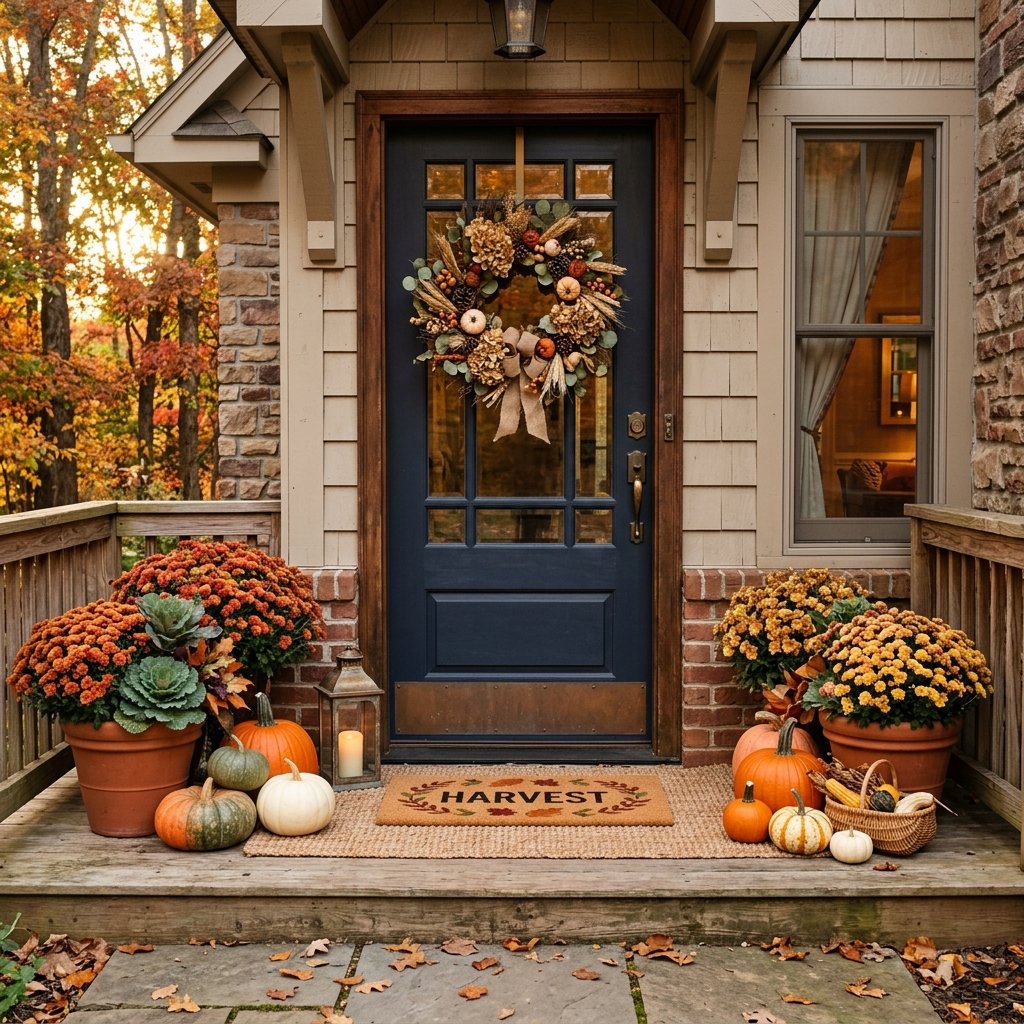
Fall Entryway Decor Ideas for a Welcoming Front Door
Most fall decorating budget and effort goes toward the inside of a house, the mantel, the kitchen counter, maybe a wreath thrown up on the door almost as an afterthought. Meanwhile the entryway is the one spot in the entire home that neighbors, delivery drivers, and every single guest actually see up close, often before anything else.
It is also the spot most likely to get redone twice more before winter, once for Halloween and again for Thanksgiving, which usually means three separate shopping trips instead of one thoughtful setup. What follows leans toward decor that holds its own from September through the end of November, along with ideas for both the door itself and the space just inside it.
Decor That Holds From September Through Thanksgiving
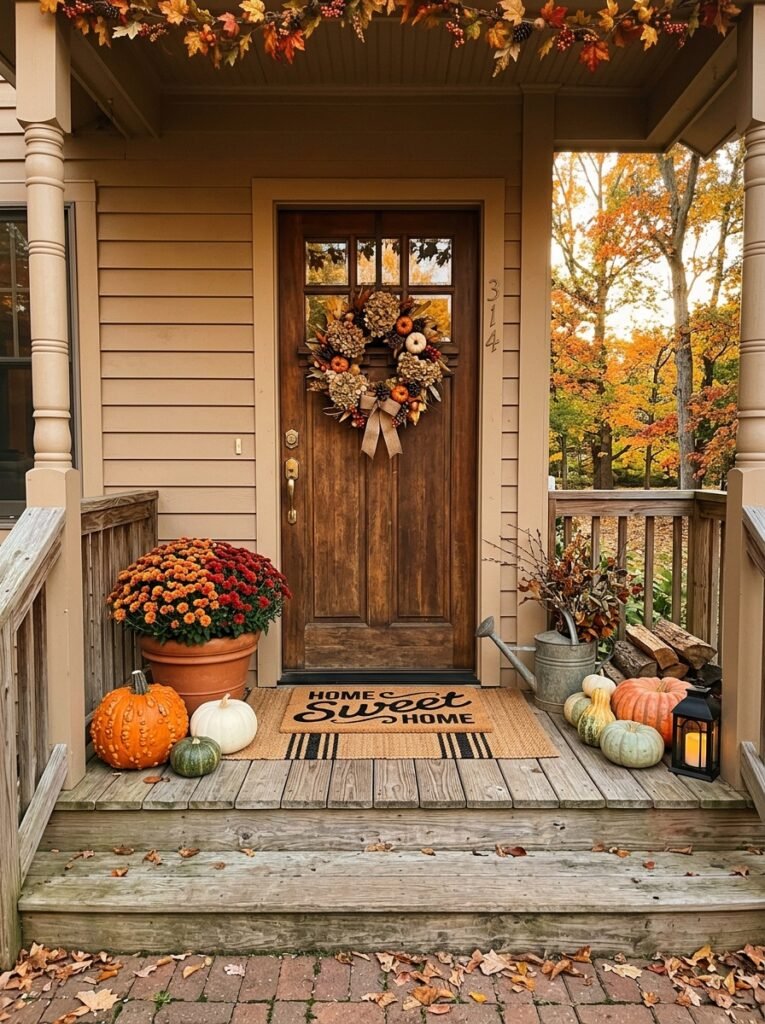
The easiest way to avoid re-decorating a front door three times in twelve weeks is choosing elements tied to the season rather than to a specific holiday. Pumpkins, gourds, wheat, and warm neutral tones read as fall in September and still make sense sitting next to a Thanksgiving table runner in late November, while anything shaped like a bat, a spider, or a turkey has a much shorter shelf life.
That does not rule out swapping in a holiday-specific accent later. A small Halloween touch added to an otherwise neutral fall setup, or a cluster of dried corn added closer to Thanksgiving, refreshes the look without requiring the whole display to come down and start over.
This approach also tends to cost less over the full season, since a base of durable, neutral pieces gets reused rather than replaced twice, and the only recurring expense is a handful of small accents swapped in and out as the calendar moves along.
The Door Itself
The door carries more visual weight than anything else at the entry, since it is usually the largest single surface and the one a visitor faces directly while waiting for someone to answer.
A Wreath Built From Texture, Not Just One Symbol
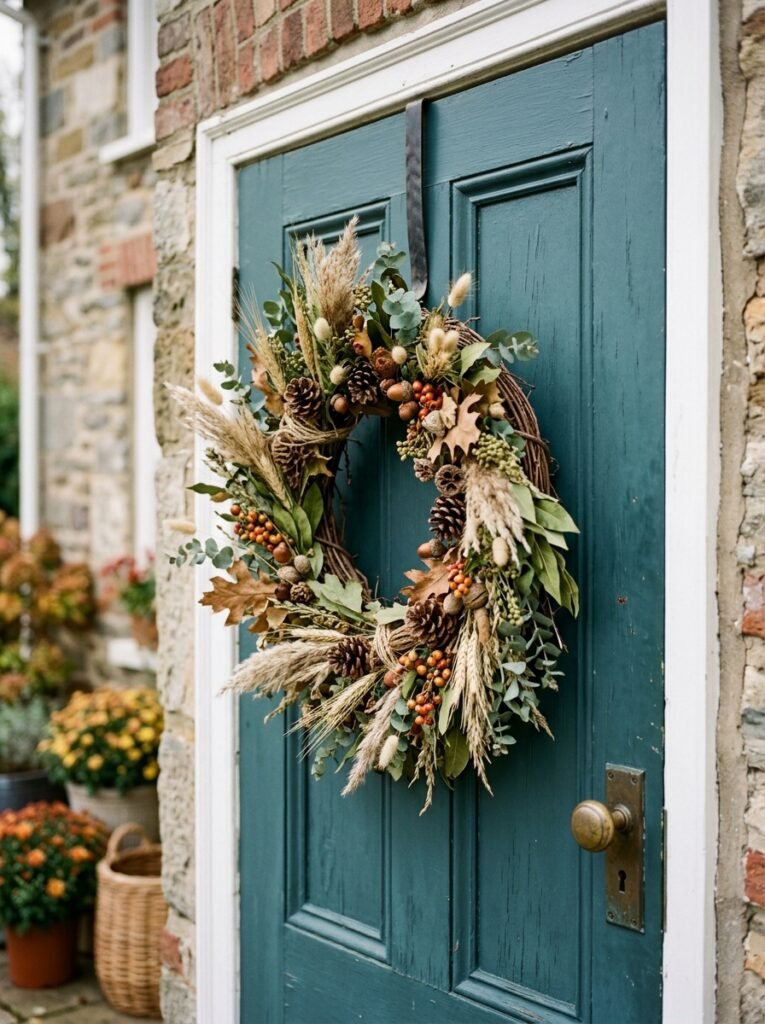
A wreath made from a single material, all faux leaves or all mini pumpkins, tends to look flatter than one built from mixed textures: dried grasses, a few dried florals, some subtle greenery, and a small cluster of natural elements like pinecones or cotton stems. Mixing two or three textures gives a wreath depth even from a distance, which matters since most wreaths get seen from the sidewalk or driveway before anyone reaches the porch.
An over-the-door wreath hanger, rather than a nail or hook screwed into the door frame, keeps the door itself untouched, which matters for both renters and anyone who would rather not patch a hole later. The same no-damage logic used for hanging things in a dorm room without leaving marks applies just as well to a front door.
Layering the Doormat Instead of Replacing It
A single doormat does the practical job of catching dirt, but layering a smaller decorative mat on top of a larger, plainer one adds visual interest without sacrificing function. The bottom mat, usually a coir or rubber-backed style, takes the actual foot traffic and weather, while the top layer can be swapped seasonally without buying an entirely new functional mat each time.
Sizing matters here. The top mat should sit noticeably smaller than the base one, leaving a visible border, rather than nearly matching it edge to edge, which reads as intentional layering instead of two mismatched mats stacked by accident.
Small Hardware Changes That Read as Seasonal
A door knocker, a house number plaque, or even the finish on existing hardware contributes to the overall feel of an entry more than people usually expect. Swapping a bright brass knocker for a matte black or aged bronze one, even temporarily, shifts the whole door toward a warmer, more autumnal read without touching paint or anything structural.
Removable hardware overlays and adhesive-backed accent pieces exist for exactly this kind of temporary swap, and most come off cleanly enough to restore the original look before a lease ends or a home sale begins.
What Flanks the Door
The area on either side of the door usually has more square footage to work with than the door itself, and it is where most of the seasonal color and texture actually lives.
Planters That Last Past the First Frost
Mums are the default fall planter choice for a reason, but not every mum variety tolerates a hard frost equally well, and a planter that dies in early October leaves two more months of the season with an empty pot by the door. Checking a plant’s cold tolerance against the USDA’s plant hardiness zone map before buying helps match the planting to what a specific region’s fall and early winter temperatures will actually do.
Ornamental kale, flowering cabbage, and certain grasses hold up through much colder temperatures than mums and often look better as the season progresses rather than fading by mid-October. Mixing one of these longer-lasting plants into a planter alongside mums extends how long the whole arrangement looks intentional rather than spent.
Pumpkins and Gourds Without the Predictable Stack
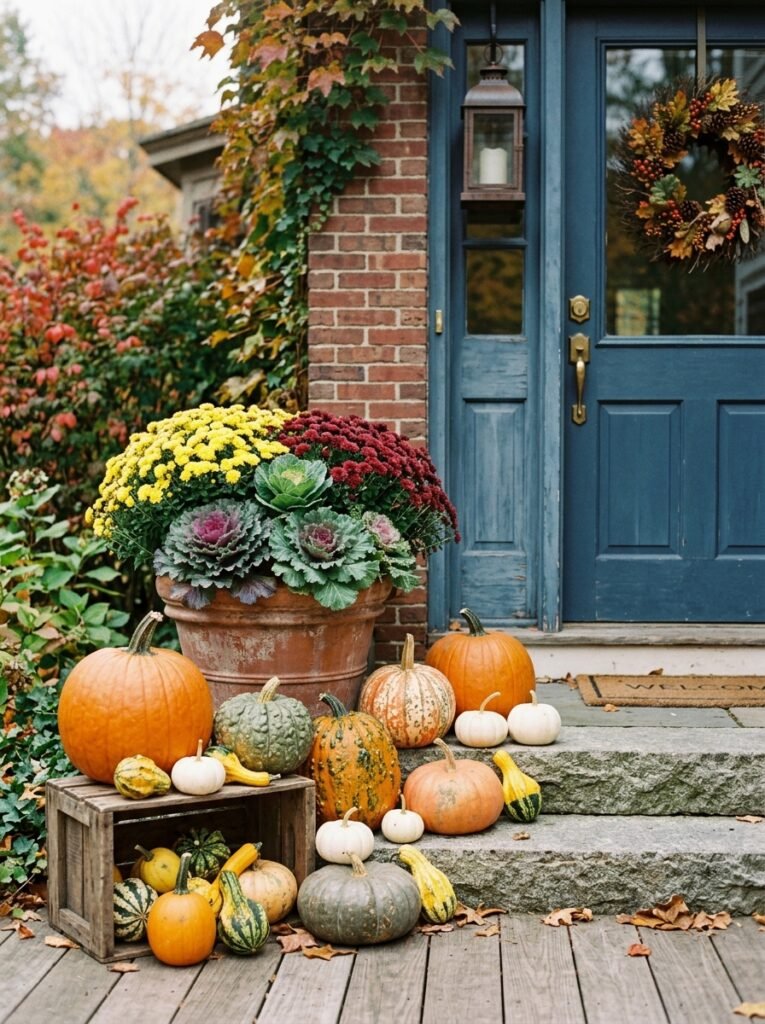
Three same-size orange pumpkins stacked or lined up in a row is the default arrangement, and it is also the one that reads as the least considered. Varying the size, shape, and color, mixing a few white or blue-gray pumpkins with traditional orange ones, and grouping them in odd numbers rather than even ones, gives the same basic material a more deliberate look.
Placing pumpkins at varying heights, some directly on the ground and a few raised on a low stool, a stack of crates, or an overturned bucket, adds dimension that a flat row on the porch floor does not.
Lighting for the Earlier Sunset
Fall brings noticeably earlier sunsets, which means an entry that looked fine in daylight all summer suddenly needs to hold up in low light for a much larger part of the evening. A pair of lanterns flanking the door, whether battery-powered flameless candles or solar-charged outdoor lights, extends how welcoming the entry feels well past dinnertime.
Warm-toned bulbs, rather than a cool white porch light, match the overall mood of a fall setup better and photograph more accurately if the entry is ever shared online. Swapping just the porch light bulb for a warmer color temperature is one of the lowest-cost changes on this entire list.
The Walkway and Porch Floor
The stretch between the sidewalk and the front door often gets skipped entirely, even though it sets the tone before a visitor reaches the door at all.
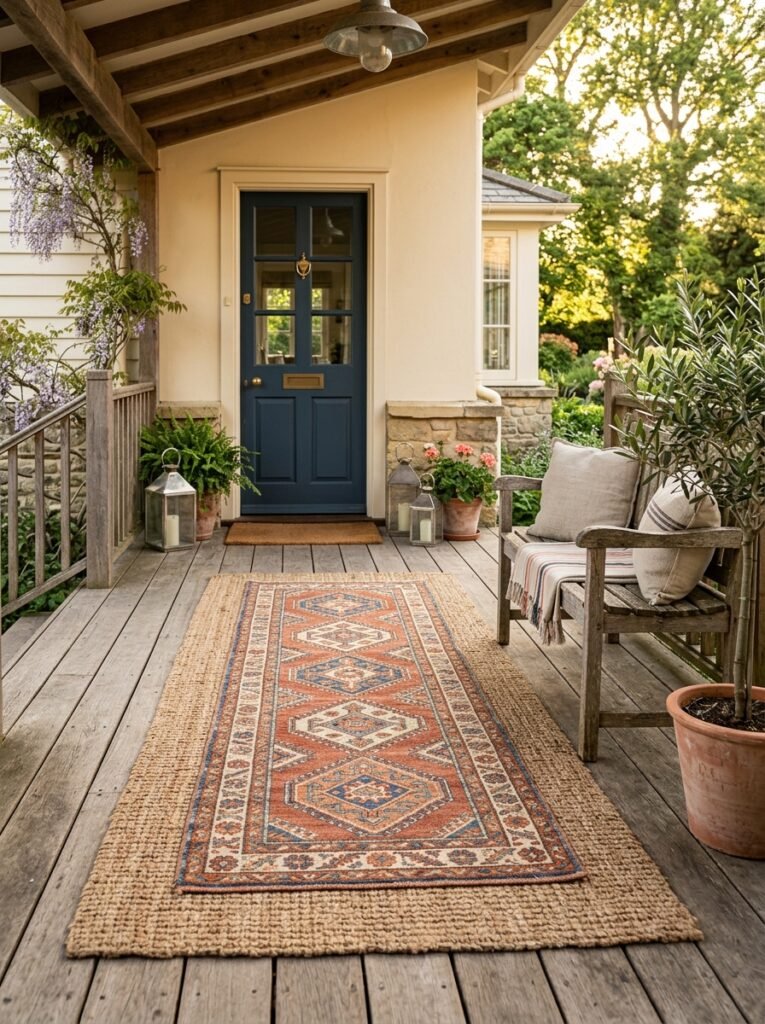
A runner rug across a porch floor, sized to fit the space without needing to be trimmed, adds warmth underfoot and ties the planters and door decor together visually. Outdoor-rated rugs handle rain and temperature swings far better than an indoor rug pressed into service outside, which tends to mildew within a season.
A small bench or a pair of stools, if the porch has room, gives the space a sense of purpose beyond simply being a path to the door, and it doubles as a spot to set down bags while getting the door open on a cold evening.
Just Inside: Styling the Interior Entryway
The space immediately inside the front door gets far less seasonal attention than the exterior, even though it is the first interior impression a guest gets.
A Console or Entry Table Vignette
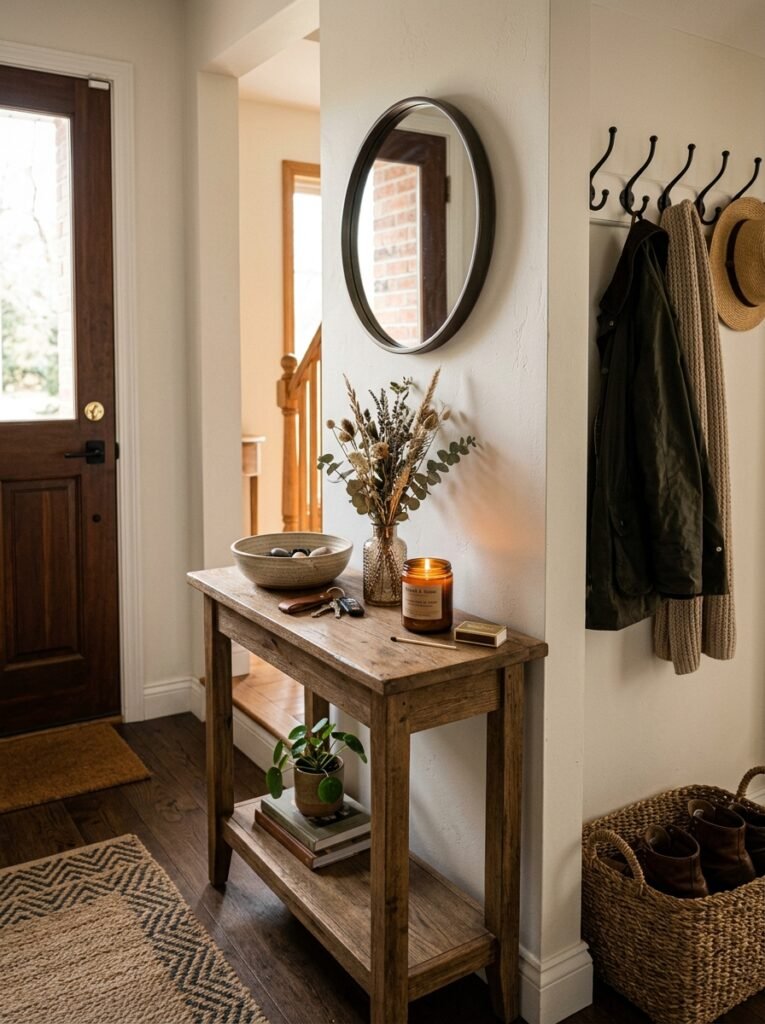
A small table just inside the door, if there is room for one, works well with a tight grouping of three to five items rather than a scattered collection: a low bowl for keys, a small vase with dried stems, and a single candle or piece of seasonal decor. Odd-numbered groupings at varying heights read as more considered than a symmetrical, evenly spaced row.
A table pushed against a wall in a narrow entry hall benefits from the same footprint thinking covered in the site’s guide to small apartment layouts, since an entryway often deals with the exact same walkway-width constraints as a tight living room.
A Catch-All for Coats, Bags, and Mail
Fall means heavier coats, and a hook or small rack dedicated to them keeps the entry from becoming a pile-up of jackets draped over a chair. A shallow tray or small basket for mail and keys, placed at the entry rather than the kitchen counter, catches that clutter before it migrates further into the house.
Layering in a seasonal touch, a small pumpkin on the console, a bowl of pinecones by the tray, keeps the functional catch-all zone from looking purely utilitarian.
Securing Anything Tall or Leaning
A leaning mirror, a tall vase, or a narrow console with decor stacked on top all carry more tip-over risk in a high-traffic entry than the same pieces would in a quieter room, especially with kids or pets moving through quickly on the way out the door. A simple anti-tip strap or wall anchor, the kind covered in the CPSC’s Anchor It campaign, takes only a few minutes to install and matters more in an entryway than almost anywhere else in the house.
Materials That Hold Up Outdoors All Season
Anything left outside for three months faces sun exposure, rain, and in many regions an early frost, which rules out a fair number of materials that look right in a store display but do not last on an actual porch.
- Faux florals rated for outdoor use resist fading far longer than indoor versions, which can noticeably bleach within a few weeks of direct sun exposure.
- Metal and resin planters handle freeze-thaw cycles better than ceramic, which can crack if water gets into the material and freezes.
- Battery-powered lanterns avoid the fire risk and wax mess that real candles create in an uncovered, windy entry space.
- Sealed or painted wood holds up to rain better than raw, unfinished wood, which can warp or splinter after a single wet month.
- Wire or metal wreath forms keep their shape through wind and rain better than foam bases, which can absorb moisture and sag over the season.
Common Mistakes That Undercut a Fall Entryway
A handful of choices work against an otherwise well-planned setup, even when the individual pieces are right.
- Matching every element too closely. A wreath, mat, and planters all in the exact same shade of orange reads as a matched set from a catalog rather than a considered space. Varying the shade slightly across pieces looks more intentional than an exact match.
- Overcrowding a small porch. Too many pumpkins, planters, and accessories in a tight entry makes the space feel cluttered rather than welcoming, and it can block the actual path to the door.
- Ignoring the transition zone just inside the door. Effort spent entirely on the exterior, with a bare or cluttered interior entry, undercuts the welcoming effect the moment a guest actually steps inside.
- Choosing decor with a short shelf life. Elements tied specifically to Halloween, put up in early September, either need replacing twice or linger awkwardly well past the holiday they were meant for.
- Skipping lighting until it gets dark early. Waiting until the first genuinely dark evening to notice the porch light situation means missing several weeks where the entry could have already looked finished after sunset.
Quick Questions
When is the right time to put up fall entryway decor? Early to mid September works for most regions, since it gives the display time to be enjoyed before the weather turns and avoids the compressed feeling of decorating and redecorating within the same few weeks as Halloween.
Do mums need to be replaced partway through fall? Not necessarily, if a cold-tolerant variety is chosen from the start and the planter gets checked periodically for soil moisture. A mum that wilts by October was often either the wrong variety for the climate or simply underwatered, rather than naturally reaching the end of its bloom.
Is it worth buying an outdoor rug just for a porch? For a porch that gets regular use or visible weather exposure, yes. An indoor rug used outside typically shows mildew or fading within a single season, while an outdoor-rated version is built to handle both and usually costs a similar amount.
How many pumpkins is too many for a small porch? There is no fixed number, but a small porch usually looks more finished with one deliberate grouping of three to five varied pumpkins than a dozen scattered pieces competing for the same few square feet. Scale relative to the porch size matters more than the total count.
Does the interior entryway need to match the exterior decor exactly? Not exactly, but sharing a color or two between the outside and the inside makes the transition feel connected rather than like two unrelated projects. A single repeated element, the same shade of dried florals or a matching neutral tone, is usually enough to tie the two spaces together without requiring an identical setup.
A front door does not need a full redecoration to feel considered, and it does not need three separate seasonal refreshes to make it through fall. Picking a base of textures and colors that work from the first cool morning through the last plate of Thanksgiving leftovers covers most of what an entryway actually needs. More seasonal ideas for the rest of the house are collected in the site’s seasonal decor section.