

Curtain Bangs for Round Face Shapes: What to Ask For and How to Style Them
Curtain bangs get requested more than almost any other fringe style, and round faces get told to avoid bangs more than almost any other face shape. Put those two things together and a lot of people walk into consultations unsure whether the style will actually work for them, or whether a stylist is about to talk them out of it.
The short answer is that curtain bangs are one of the few fringe styles built to work with a round face rather than against it. The longer answer involves length, parting, and a few details that separate a curtain fringe that slims the face from one that just adds hair to the middle of it.

Why Curtain Bangs Suit a Round Face in the First Place
Most fringe styles run straight across the forehead. A blunt, heavy fringe does that, and so does a full baby fringe. Both add width at the exact point where a round face already has the least length to spare, which is why they tend to get ruled out for this face shape.
Curtain bangs do the opposite. They split down the center and sweep to either side, following the natural curve of the cheekbones instead of cutting a straight line across them. That parting creates a diagonal, and diagonal lines read as longer than horizontal ones. The forehead stays partly visible instead of fully covered, which keeps proportion in the upper half of the face rather than compressing it.
The layers around the face also catch light differently than a blunt cut does, and that softness works in favor of rounder features rather than emphasizing the curve of the jaw and cheeks.
None of this means curtain bangs work identically on every round face. Length, thickness, and where the part sits all change the result, sometimes by a significant margin.
The Length That Actually Elongates
Length is where most curtain fringe requests go wrong for round faces, and it usually goes wrong in the same direction: too short.
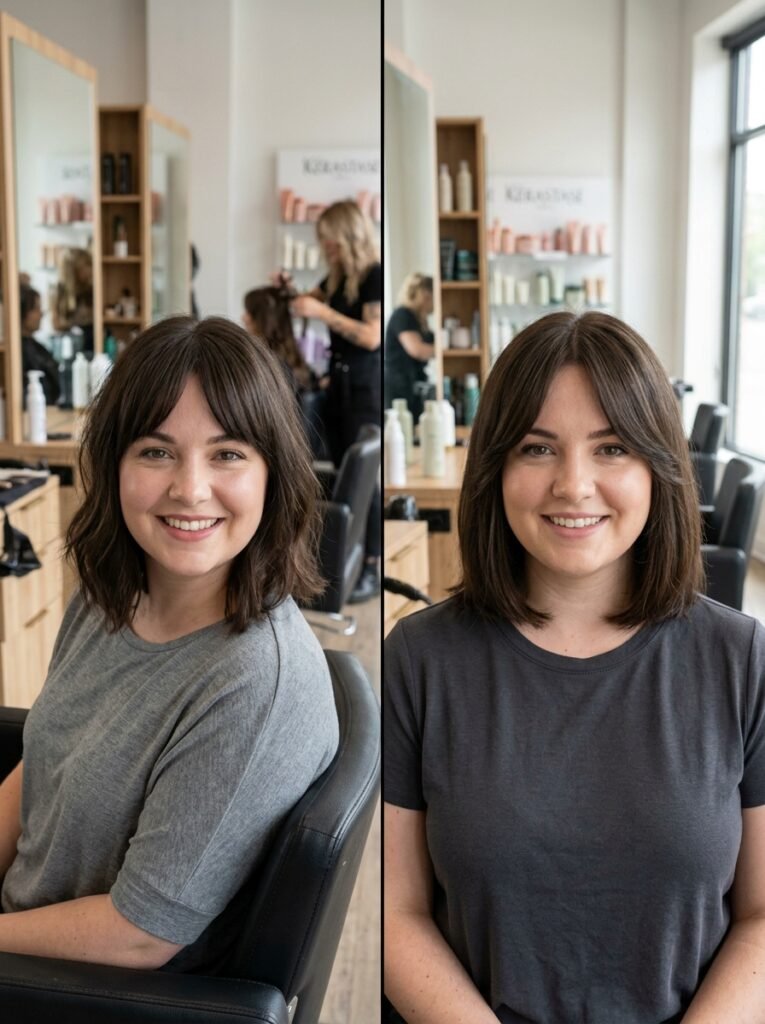
A curtain fringe that hits mid-cheek or shorter tends to frame a round face rather than lengthen it, because the eye stops at the hairline and reads the width there. The elongating effect depends on the fringe reaching past the widest point of the cheek, ideally down toward the jawline or slightly below it. That extra length carries the eye downward instead of stopping it partway across the face.
A useful way to phrase this at the consultation: ask for the shortest point of the fringe to land at or below the cheekbone, not above it. Stylists sometimes default to a shorter, bouncier curtain because it photographs well, and that version suits an oval or long face far better than a round one.
Layering matters as much as the starting length. A heavily graduated fringe with short pieces mixed through the front creates the same width problem as cutting it short across the board, even if the longest strands reach the jaw. Longer, fewer layers keep the line clean and the elongating effect intact.
Where the Part Sits Changes the Whole Effect
Curtain bangs start from a center part by definition, but how wide that part sits and how the two sides are weighted still varies.
A narrow, tight part keeps more hair falling forward on both sides, which adds fullness near the temples and can widen the upper face. A wider part, opened enough to show two or three inches of forehead at the crown, narrows that same area and lets the diagonal lines do their job without competing with extra volume.
Slightly asymmetric curtain bangs, where one side sits a touch longer or fuller than the other, tend to suit round faces better than a perfectly even split. Total symmetry emphasizes the roundness by mirroring it. A small asymmetry breaks that mirror effect without looking uneven in photos.
This is a detail worth mentioning by name at the salon, since a lot of stylists default to even, matched sides unless asked otherwise.
What to Say at the Consultation
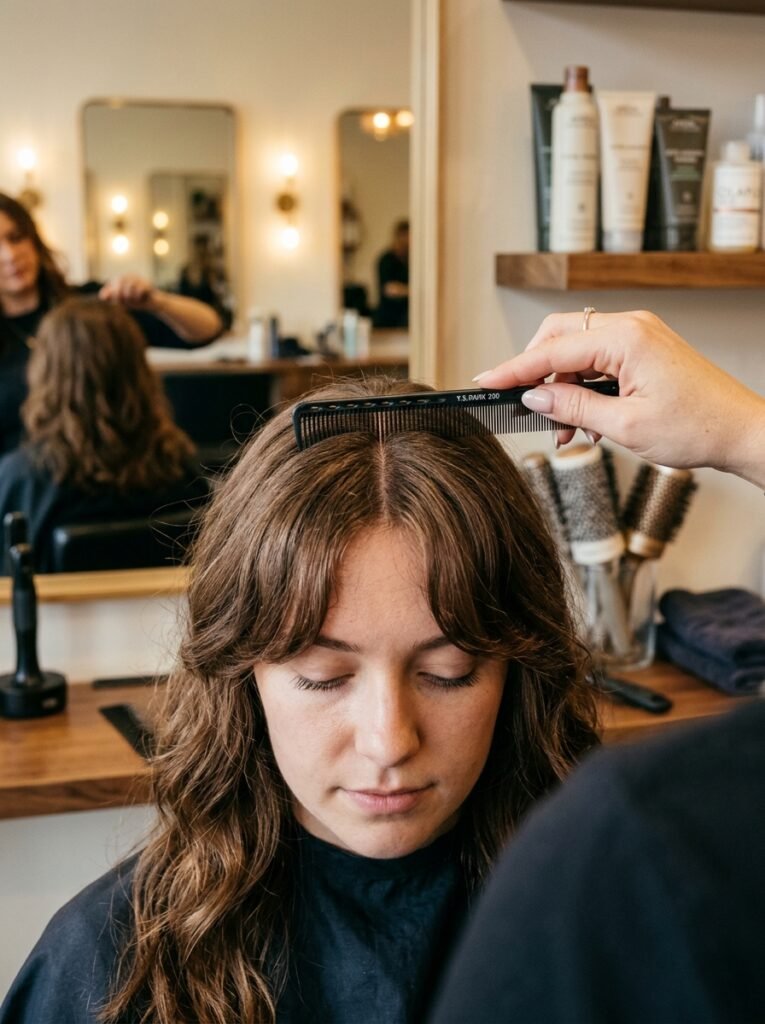
A photo helps, but a photo taken on a different face shape and hair texture translates unevenly. Pairing the image with specific wording gets closer to the intended result.
A request that tends to work well: curtain bangs that hit around the jawline, parted a little wider than center, with soft layering rather than heavy graduation, and slightly longer on the sides than the center. That single sentence covers length, part width, layering, and shape in a way a photo alone often does not.
It also helps to say how much forehead should show. Some curtain fringes are cut to graze the brow at the center part, others are cut higher to leave more forehead visible. Round faces generally read as more balanced with a bit more forehead showing at the crown, since that space adds visual height.
Bringing up face shape directly is fine and often useful. A stylist who knows the goal is elongation rather than volume will cut differently than one aiming for a fuller, bouncier fringe.
Hair Texture Changes the Outcome
The same cut behaves differently depending on texture, and round face shapes tend to be more sensitive to that difference than other shapes.
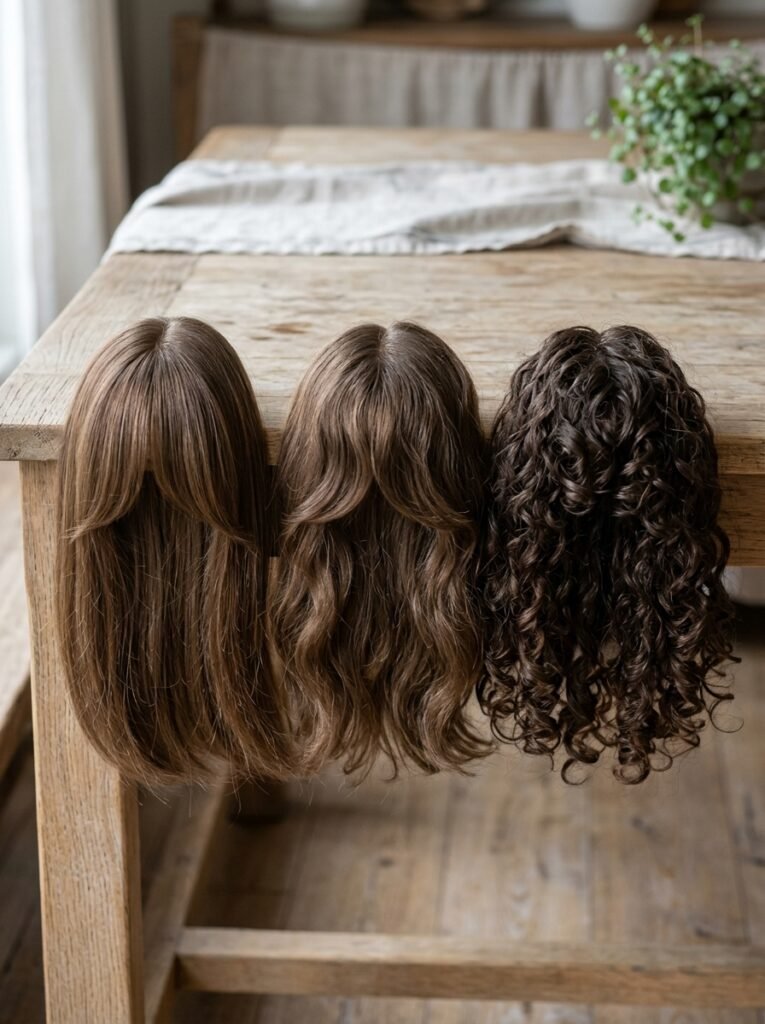
Straight, fine hair falls close to the face and shows the parting and layering clearly, which usually works in favor of the elongating effect. Wavy hair adds natural movement that can shorten the visual length slightly, since waves pull strands upward and inward. Curly and coily hair shrinks more dramatically, meaning a fringe cut to jaw length while dry may sit noticeably higher once it dries into its natural pattern.
For wavy to curly textures, asking for the length to be checked dry rather than wet prevents the fringe from ending up shorter than planned. A stylist working from wet hair alone has to estimate shrinkage, and that estimate is not always accurate on the first cut.
Thick hair holds more weight in the fringe and tends to need a slightly longer cut to achieve the same visual drape that thinner hair gets at a shorter length. Fine hair moves more freely and can look thin if cut too heavily, so a lighter hand with the layering usually reads better.
Styling for Daily Wear
Curtain bangs need some daily shaping to keep the sweep intact, though the routine is shorter than most people expect.
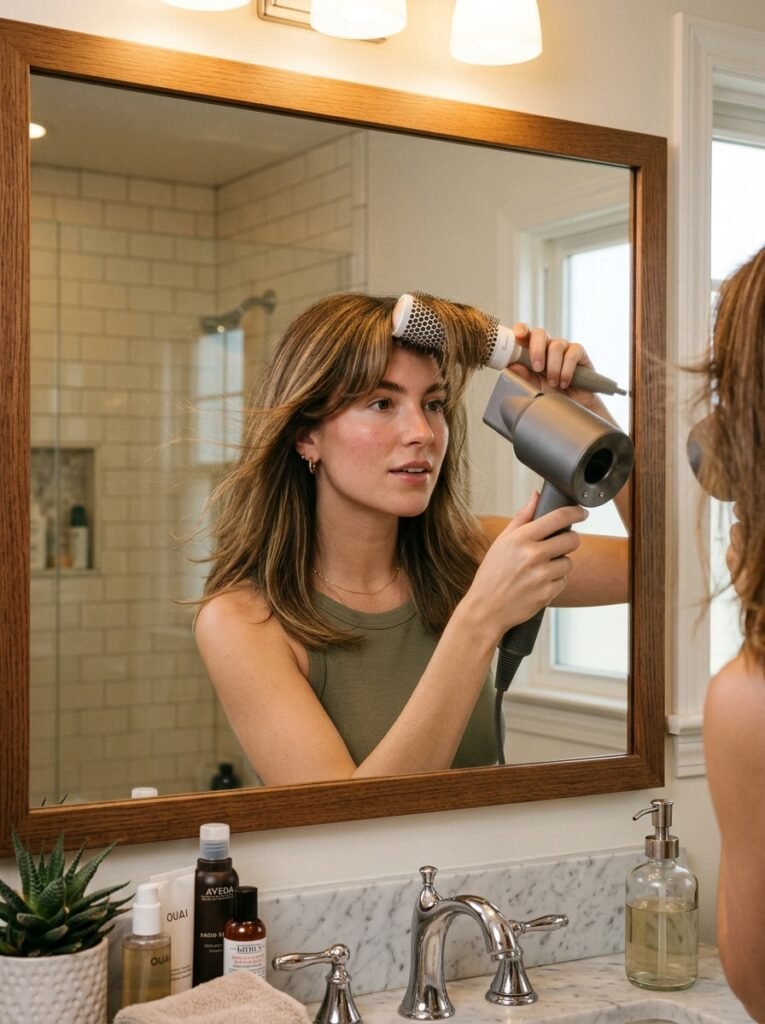
A round barrel brush, roughly one to one and a half inches, works well for setting the curve while blow-drying. Section the fringe down the center, then dry each side outward and slightly back, following the direction the hair naturally wants to fall. A cool shot at the end helps the shape hold longer through the day.
For second or third day hair, a small amount of dry shampoo at the roots followed by a quick pass with a curling wand, wrapped loosely around the barrel and released without clamping, refreshes the bend without a full restyle.
Air-drying works for wavy and curly textures, though a light curl cream applied to damp hair keeps the front pieces from puffing wider than the rest of the style, which matters more for round face shapes than most others since added width at the temple undoes some of the elongating effect.
A silk or satin pillowcase reduces the amount of daily reshaping needed, since cotton tends to flatten and frizz the front pieces overnight.
Growing Out and Maintaining the Line
Fringe grows roughly half an inch a month, and curtain bangs handle that growth better than most fringe styles because there is no hard blunt line to maintain. The layered, swept shape simply gets longer and blends into the rest of the hair over time.
A trim every four to six weeks keeps the shortest point near the intended length. Skipping trims is workable for a few extra weeks since the style forgives growth more than a blunt fringe does, but past two months most curtain fringes start behaving like face-framing layers rather than a defined fringe, which changes the elongating effect.
Trimming at home between salon visits is possible for very light dusting, using sharp shears and cutting small amounts vertically into the ends rather than straight across, but it carries real risk of unevenness. A slightly long fringe is easy to fix at the next appointment. A too-short one is not.
For anyone growing bangs out entirely, the transition period runs through several awkward lengths, and round face shapes tend to feel that awkwardness more, since the in-between lengths often sit at exactly the cheek width that adds visual bulk rather than length. Face-framing clips or a soft side part can bridge that stretch until the hair reaches a length that works loose. Ideas for managing hair through transitional lengths and quick routines are covered in the site’s guide to getting hair ready without much time in the morning.
Common Mistakes on Round Faces
A handful of choices consistently work against the elongating effect, even when the base cut is right.
Cutting the fringe too short is the most frequent issue, covered above, but a few others come up regularly. Heavy, blunt-cut curtain bangs without softened ends create a hard horizontal edge along the bottom of the fringe, which cancels out the diagonal shape that makes the style work. Asking for the ends to be point-cut or feathered rather than blunt-cut across avoids this.
Styling both sides identically straight back rather than following their natural forward sweep removes the framing effect entirely and turns curtain bangs into simple face-framing layers, which do not carry the same elongating benefit.
Too much volume at the crown competes with the slimming effect of the fringe. A curtain fringe paired with heavy root lift or a very full blowout at the top of the head adds width right where the round face needs length instead.
Skipping the wide part and going with a narrow, tight center part reduces forehead visibility and brings the fullness in closer to the face, working against the same elongation the style is meant to create.
Curtain Bangs With Different Hair Lengths
The style works across most hair lengths, though the framing shifts slightly depending on what the fringe connects to.
On a lob or shoulder-length cut, curtain bangs blend into face-framing pieces that continue the same diagonal line down through the rest of the hair, which extends the elongating effect further than the fringe alone.
On long hair, the fringe reads more as an accent, and the overall length of the hair does most of the visual work, with the bangs adding softness at the top rather than carrying the main shaping effect.
On shorter, chin-length or bob cuts, curtain bangs need closer attention to length ratio, since a short bob paired with a too-short fringe can compound the width issue rather than balancing it. A longer curtain fringe against a shorter base cut usually reads better than matching the two lengths closely.
Curly hair at any length benefits from slightly longer bangs than the straight-hair guideline suggests, to account for the shrinkage discussed earlier. More on how texture affects layering and shape choices in general is covered in the site’s piece on medium-length layers cut for fine, low-volume hair.
A Few Common Questions
Will curtain bangs make my face look wider? Cut and styled correctly, they should not. Width tends to come from a fringe that is too short, too symmetric, or paired with heavy volume at the crown, not from curtain bangs as a category.
Do I need thick hair for this to work? No. Fine hair often takes the shape well since it drapes close to the face and shows the parting clearly. Very thick hair may need slightly longer layering to avoid excess bulk near the temples.
Can I do curtain bangs myself without a stylist? A first cut is worth having done professionally, since the length and layering need to be precise for the elongating effect to hold. Maintenance trims of small amounts between visits are more forgiving to do at home.
How long does it take to grow out if I change my mind? Roughly six months to reach a length where the fringe blends fully into the rest of the hair without needing daily styling, though it becomes wearable as face-framing layers well before that.
Does forehead size matter separately from face shape? Somewhat. A very short forehead paired with a round face may want the fringe parted slightly higher to avoid crowding, while a taller forehead has more room for the wider center part.
Getting the Cut Right the First Time
The details that matter most for a round face come down to three things: enough length to reach the jaw or below, a part wide enough to show some forehead at the crown, and soft, feathered ends rather than a blunt line. Those three choices do more work than the general idea of curtain bangs itself.
Bringing that level of detail into the consultation, rather than a single reference photo, gives a stylist a clear target and reduces the chance of a first cut landing shorter or blunter than intended. More hairstyle guides organized by length and texture are available in the site’s hairstyle section.