Small Bathroom Storage Ideas That Don’t Require Renovation
Bathrooms carry more daily-use items per square foot than almost any other room, yet they are usually the smallest room in the house and the one where renovation is least likely to happen anytime soon. Most storage advice assumes a homeowner ready to add built-in shelving or swap out a vanity, which leaves renters, and plenty of owners not ready for that project, without much to work with.
What follows sticks to storage that goes in and comes back out without a contractor, a drill into tile, or a plumbing change, organized by where the space actually is rather than by what looks good in a photo.
What Makes Bathroom Storage Different From Every Other Room
A bedroom or living room mostly deals with dust and daily clutter. A bathroom adds humidity, standing water, and hardware that has to hold its grip through repeated temperature swings, and that changes which products actually work here.
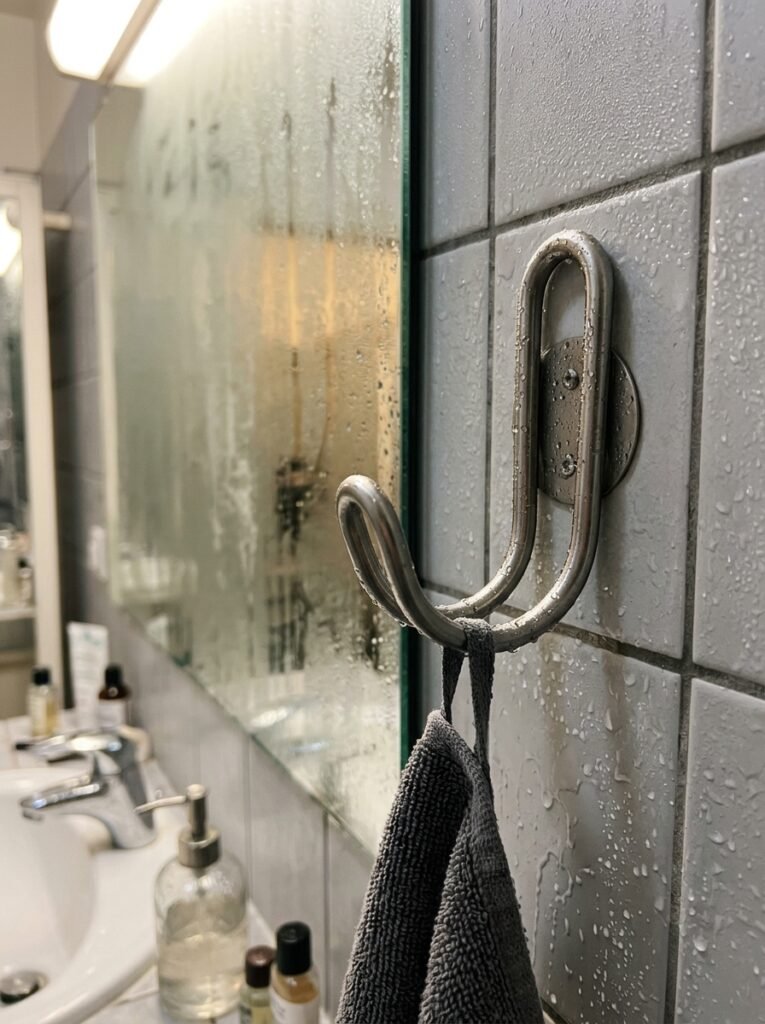
Adhesive strips rated for a living room wall often underperform in a bathroom, since heat and moisture from showers weaken the bond over time. Suction mounts fail the same way if the surface stays damp. Anything installed near a shower or tub needs a rating built for wet rooms specifically, not a general-purpose version borrowed from another part of the house.
Floor space is also usually spoken for before storage enters the picture. A toilet, a vanity, and a tub or shower claim most of a small bathroom’s footprint, leaving narrow strips of usable wall and a handful of awkward corners to work with.
Vertical Space Does Most of the Work
Once the floor is accounted for, height is what is left, and most small bathrooms leave several feet of wall completely empty above eye level.
Over-the-Toilet Storage That Doesn’t Touch the Tank
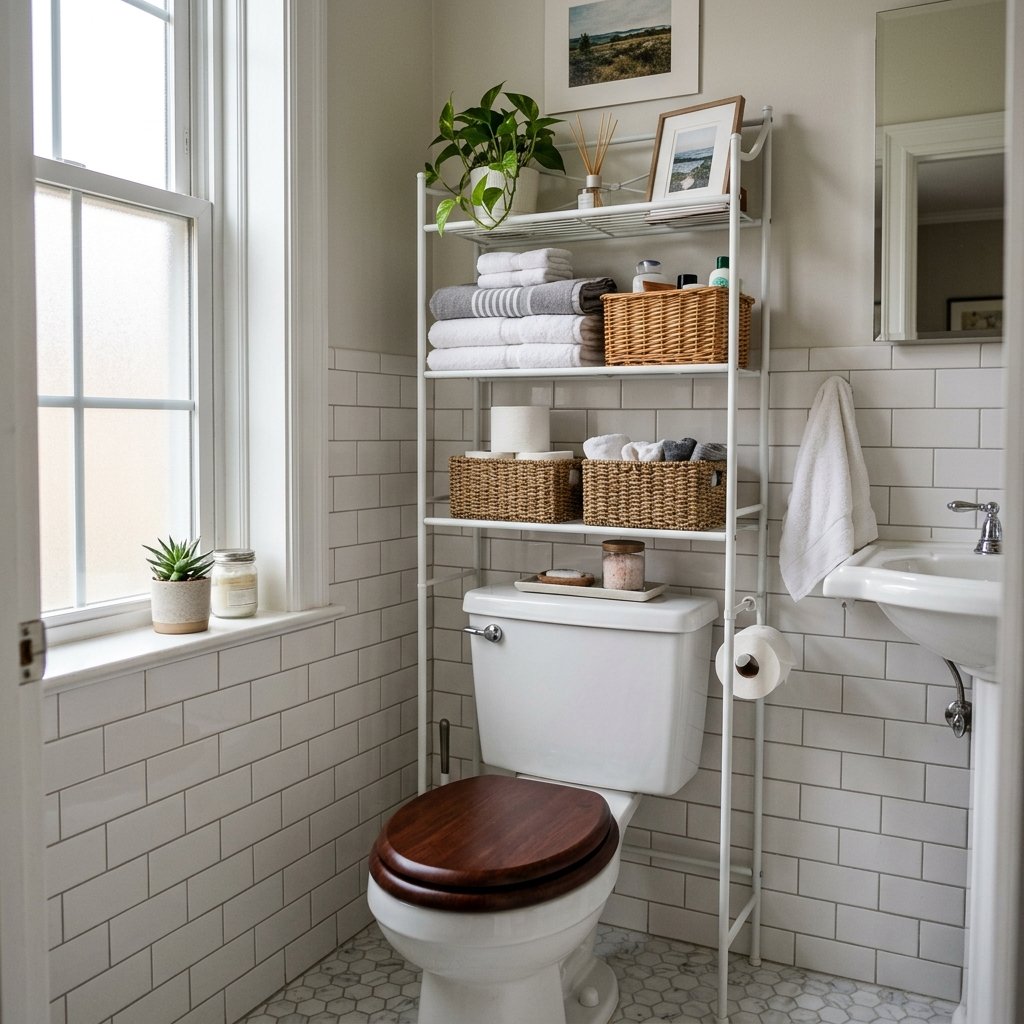
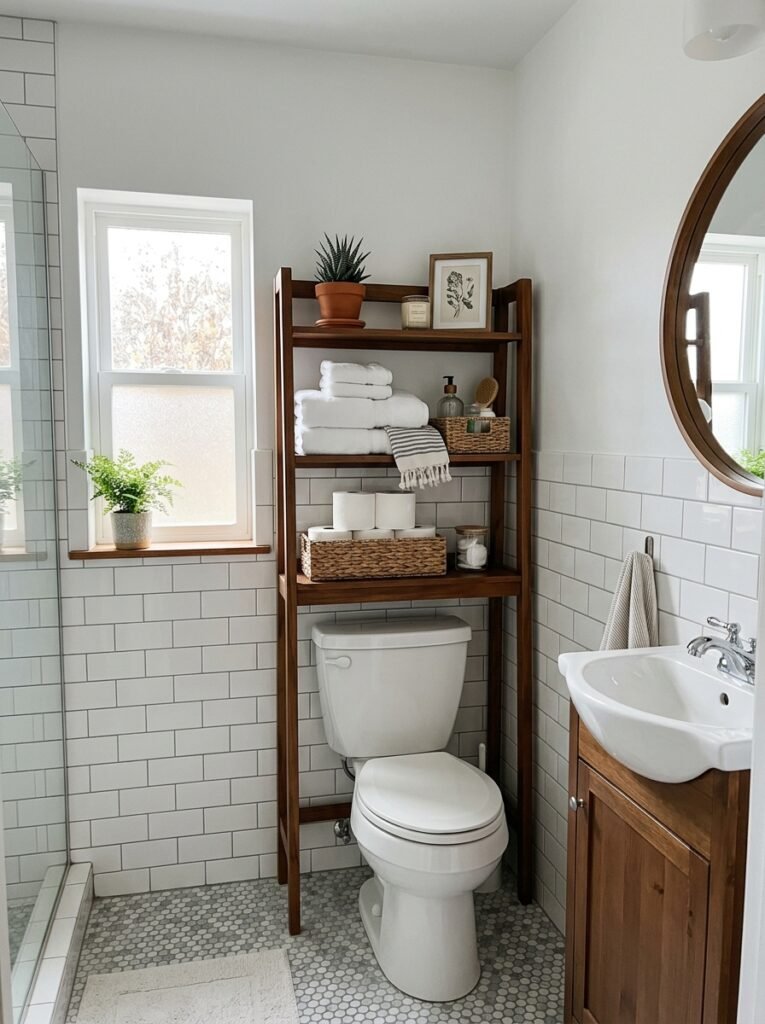
A freestanding étagère that straddles the toilet tank, rather than mounting to the wall, uses one of the few open zones in a small bathroom without any installation at all. These units typically come in adjustable widths, so measuring the tank’s width and the distance to the side walls before buying prevents an awkward fit.
Look for a base with rubber feet or a non-slip pad, since a tall, narrow unit on tile can shift more than expected, especially once it is loaded with towels or bins.
Tension-Mounted Shelving Instead of Drilled Shelving
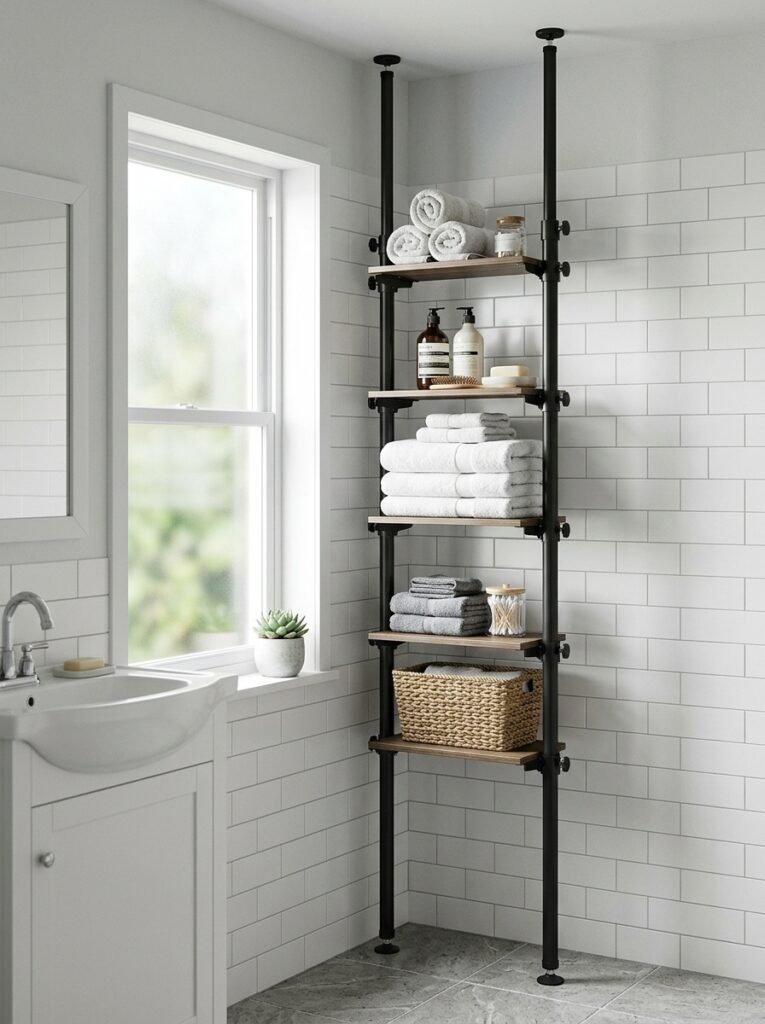
Tension rods and tension-pole shelving systems wedge between the floor and ceiling or between two walls using spring pressure rather than screws, which makes them one of the few shelving options that leaves zero marks. A pole system in a corner or beside the vanity adds several shelves worth of storage in a footprint of under a square foot.
Weight capacity varies significantly between models, so checking the per-shelf rating before loading it with anything heavy, like a stack of towels or a small appliance, avoids the sagging that gives these systems a bad reputation.
Wall Space Above the Door
The strip of wall above a bathroom door is almost always empty and almost always ignored. A slim floating shelf installed with a heavy-duty adhesive strip rated for the weight, rather than a drilled bracket, holds extra towels, a first aid kit, or overflow toiletries without needing a stud.
This spot works best for items used infrequently, since reaching it usually means a step stool, but that trade-off is often worth it for an otherwise wasted six inches of depth running the width of the doorway.
Shower and Tub Storage Without Suction or Drilling
The shower is where the most storage decisions go wrong, since it is also the wettest surface in the room and the hardest on any adhesive or suction product.
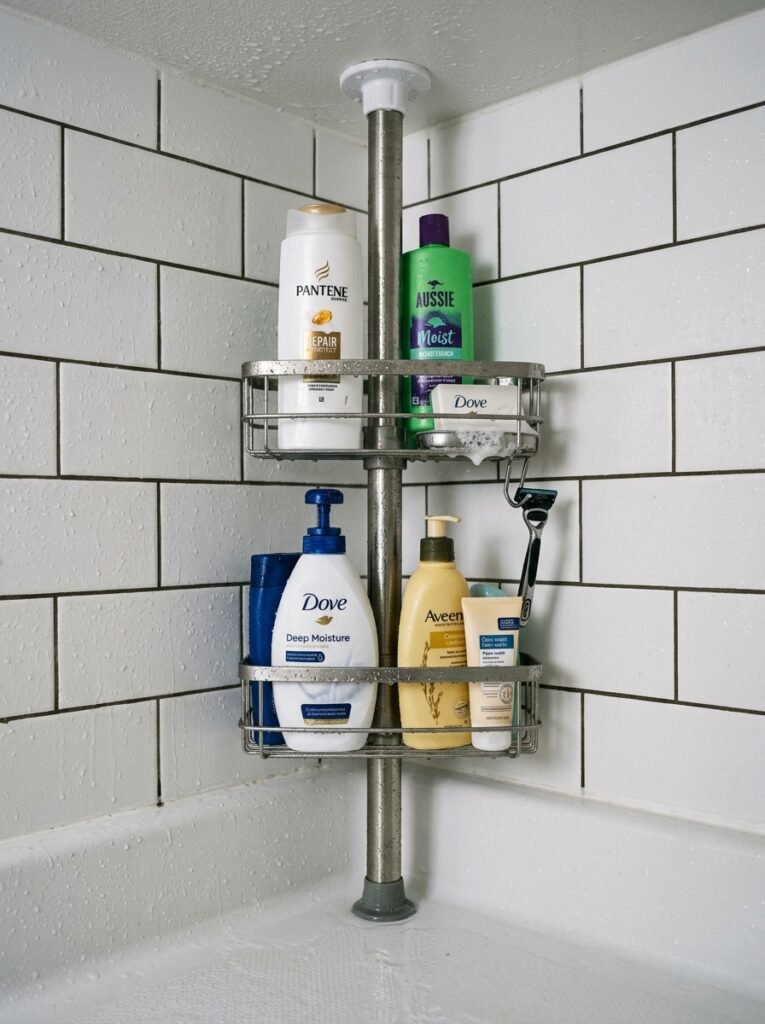
Suction caddies work in theory but fail more often than any other bathroom storage type, since suction cups lose their grip once mineral buildup or soap film coats the tile, which happens faster than most people expect. A tension-pole caddy, wedged between the tub floor and the ceiling or ledge above the shower, avoids that failure point entirely and tends to hold significantly more weight.
For a shower with a fixed head on a vertical pipe, a caddy that hangs directly from the shower arm, gripping the pipe rather than the tile or glass, is another no-drill option that skips adhesive and suction altogether. These typically hold two or three shelves of bottles at eye level, right where they are used.
Corner shelving that tensions between two adjacent shower walls, rather than mounting to either one, works in a standard shower stall and leaves both walls completely untouched. It is worth confirming the shower’s width falls within the unit’s adjustable range before buying, since very narrow or unusually wide stalls sometimes fall outside standard sizing.
Storage That Doesn’t Touch the Walls at All
For anyone who wants zero holes and zero adhesive residue on move-out, freestanding pieces solve most of the same problems without going near a wall.
Rolling Carts Under the Sink
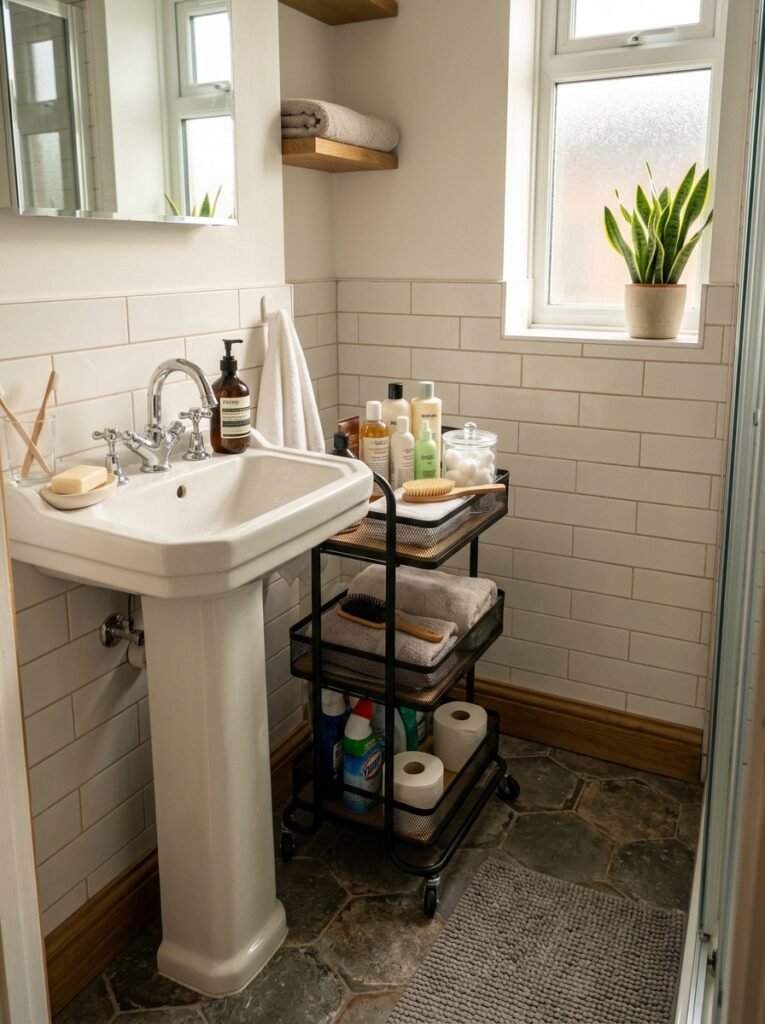
A narrow rolling cart, sized to fit the gap beside the plumbing under a pedestal or open vanity, turns awkward dead space into organized storage that pulls in and out easily. Measuring the narrowest point of the opening, not just the widest, matters here, since pipes and shutoff valves often narrow the usable width partway up.
Bins on the cart keep smaller items from sliding around every time it rolls, and a cart with a handle makes it easy to pull the whole thing out for cleaning underneath, which fixed shelving never allows.
Freestanding Étagères Beside the Tub
A slim shelving unit placed beside a tub or in an unused corner adds storage without any wall contact at all. Metal wire units resist moisture better than particleboard or unfinished wood, which matters more here than in almost any other room in the house.
Choosing a unit with a footprint under a square foot keeps it from crowding a small floor plan, and one with wheels makes cleaning behind and underneath it far easier than a stationary piece would.
Vanity-Top Trays and Stacking Bins
Not all extra storage needs height. A shallow tray on the vanity corrals daily items like a toothbrush, soap, and lotion into one zone instead of letting them spread across the whole counter, which makes a small counter read as larger even though nothing physically changed.
Stacking bins inside a vanity cabinet double the usable shelf space in a cabinet that usually has one deep, wasted layer of vertical air above whatever is stored on the bottom.
The Inside of Doors and Cabinets Is Wasted Space
Two flat surfaces exist in almost every bathroom and go completely unused: the back of the door and the inside of the vanity cabinet doors.
Over-the-door organizers, whether a simple hook rack or a pocketed fabric organizer, hang from the top of a standard door with no tools and no damage, and they hold everything from hair tools to cleaning supplies. Measuring door thickness before buying matters, since some hook styles only fit standard interior doors and slip on thicker ones.
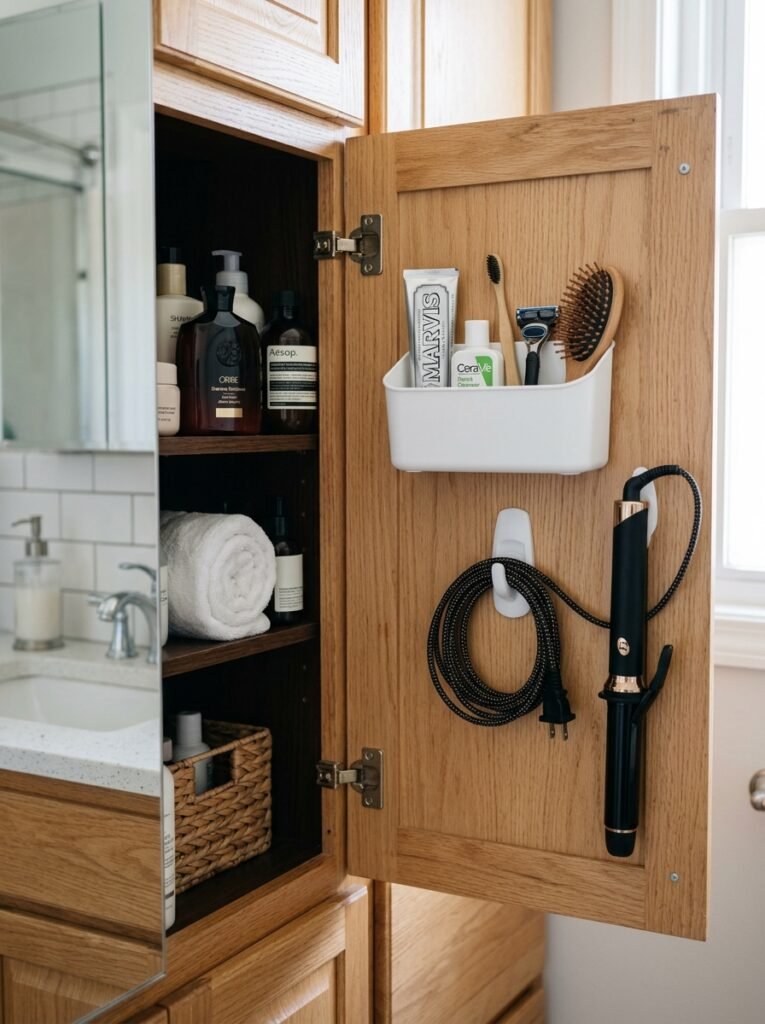
Adhesive hooks and small bins mounted to the inside of a vanity cabinet door use the one flat surface in that cabinet that almost never gets touched otherwise. A shallow bin holds spare soap or extra toothpaste, while a hook underneath handles a hair dryer cord or a small bag.
A tension rod installed just inside a cabinet, low enough to clear the shelf above it, gives spray bottles somewhere to hang by their trigger rather than tipping over every time the door opens.
Choosing Hardware That Survives Humidity
The single biggest reason no-install storage fails in a bathroom specifically, rather than in a bedroom or hallway where the same products work fine, comes down to moisture.
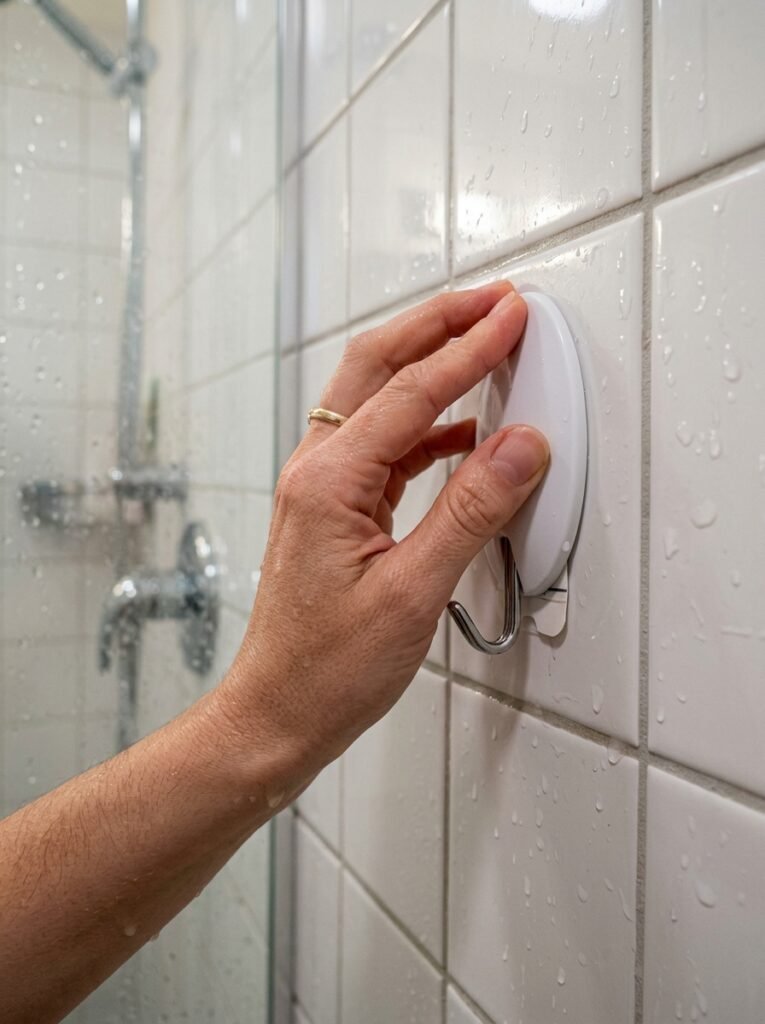
- Check the wet-room rating. Adhesive hooks and strips sold specifically for bathrooms list a weight rating for humid conditions, which is usually lower than the number printed for dry rooms. Buying based on the dry-room number is the most common reason these products fail within a few weeks.
- Favor metal and plastic over particleboard. Any storage piece that sits near a tub, sink, or shower should be made from a material that will not swell or warp if it gets splashed. Chrome, stainless, and powder-coated wire hold up far better than pressed wood in this environment.
- Wipe mounting surfaces before installing anything adhesive. Soap residue and condensation both weaken adhesive bonds significantly, and a quick alcohol wipe on the wall before applying a strip extends how long it holds.
- Let ventilation do part of the job. Running the bathroom fan or cracking a window after a shower keeps ambient humidity lower, which helps every adhesive and hardware choice in the room last longer, not just the storage. The EPA’s guide to mold, moisture, and humidity control covers ventilation habits worth adopting regardless of which storage products end up on the walls.
- Anchor anything tall and freestanding. A narrow étagère or rolling cart loaded with towels has a higher center of gravity than it looks like on the showroom floor, and a small anti-tip strap, the same kind used for furniture in rooms with kids or pets, is worth the five minutes it takes to attach in a bathroom used by both.
Storage Mistakes That Make a Small Bathroom Feel Smaller
A handful of habits undo the space these solutions are meant to create, even when the products themselves are the right ones.
- Buying storage before measuring the actual gap. A cart or shelf that looked compact online can be an inch too wide for the space beside a pedestal sink, and returns on assembled furniture are rarely simple.
- Stacking bins that do not match in height. Mismatched bin heights waste the vertical space above the shortest one in the row, even inside a cabinet nobody sees.
- Skipping the weight rating on adhesive hardware. A hook rated for two pounds holding a fully loaded robe or a heavy ceramic soap dish will eventually let go, usually at an inconvenient moment.
- Choosing wood storage for a shower-adjacent spot. Even sealed wood swells with repeated splashing over months, while metal and plastic equivalents handle the same exposure indefinitely.
- Ignoring the space above the door and behind it. These two zones alone can hold as much as a small shelving unit, and both stay empty in most bathrooms simply because they are easy to forget.
- Relying on suction alone in the shower. Soap film and hard water both weaken suction grip within weeks, which is why a caddy that falls off the tile every few days is rarely a hardware defect and almost always a suction problem.
Quick Questions
Will adhesive hooks damage bathroom paint or tile when removed? Most bathroom-rated adhesive strips are designed to release cleanly when pulled slowly and at a downward angle, though painted drywall is more prone to minor marking than tile or a sealed surface. Testing removal on a small hidden section first is a reasonable precaution in a rental.
Is tension pole shelving safe to use near a shower? Yes, as long as the ceiling and floor contact points are solid and not on an angled or textured surface, which can prevent a secure grip. Avoid loading the top shelf heavily if the pole sits directly beside a shower, since repeated door movement can loosen tension pressure over time.
What holds up better in a bathroom, metal or wood storage? Metal, almost without exception, particularly anything with a chrome or powder-coated finish. Untreated or lightly sealed wood absorbs ambient humidity even without direct splashing, which shortens its lifespan considerably compared to a similar metal piece.
How much weight can a standard bathroom-rated adhesive hook hold? It varies by brand and size, but many rate between two and five pounds for humid environments, noticeably lower than the same hook’s rating for a dry room. Checking the specific product’s wet-rating, not just its general listed capacity, avoids the most common failure point.
What is the fastest fix for a bathroom with almost no storage at all? An over-the-toilet étagère paired with a vanity-top tray covers the most ground for the least effort, since both install in minutes and address the two most visible clutter zones in a small bathroom at once. Adding a tension shower caddy after that handles the third major trouble spot without needing anything else.
None of this requires more than a tape measure, a level, and an afternoon. Working from what is already open, the wall above the door, the gap beside the sink, the inside of a cabinet door, uses space a full renovation would have covered anyway, without the cost or the wait. More small-space solutions for other rooms are collected in the site’s room by room section.